
The U.S. Fire Administration says to keep grills and fire pits at least 3 feet from your house and from anything that can burn. That includes siding, deck boards, railings, and furniture. Treat 3 feet as a minimum, then follow the clearances in your grill or fire pit manual if they ask for more.
Where the grill goes is one of the first decisions in any outdoor kitchen plan. Get it right and the space feels easy to cook in. Get it wrong and the cook ends up working inches from vinyl siding, a wood rail, or a stack of cushions.
At Big Easy Outdoor Design, grill placement is part of the layout from the first sketch. This guide explains the federal grill clearance from house guidance and where it applies. It also shows how to plan a cooking zone that keeps heat away from the parts of your home that can catch fire.
What Does the U.S. Fire Administration Recommend?
The U.S. Fire Administration, part of FEMA, tells homeowners to keep grills 3 feet away from the house and anything that can burn. Its outdoor fire safety sheet also says to move the grill away from siding, decking, and other things that can catch fire.
The same U.S. Fire Administration outdoor fire safety sheet lists a few habits that go with that distance:
- Keep children and pets at least 3 feet away from the grill when it is hot.
- Stay with the grill the entire time you are cooking.
- Keep the grill clean so leftover grease and fat will not catch fire.
Those steps are simple, but they shape the design. A cook who must stay with the grill needs a comfortable spot to stand, a place to set tools, and a clear view of guests.
Does the Same 3-Foot Rule Apply to Fire Pits?
Yes. The U.S. Fire Administration says a fire pit should be at least 3 feet from your house and anything that can burn. It also recommends a metal screen over wood-burning fires to keep sparks from floating out.
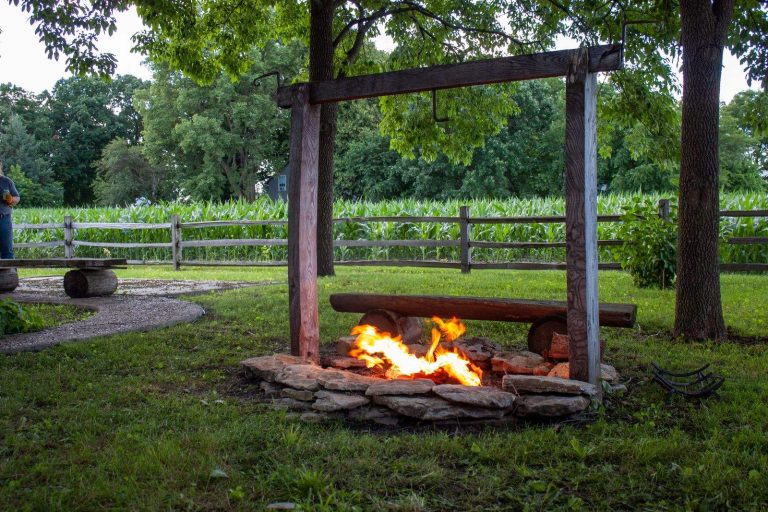
The agency also says to turn off or put out fires before you leave the backyard. It adds two more points for families.
The first is simple: watch children closely while the fire pit is in use. The second is to store matches and lighters out of their sight and reach.
In practice, many backyards give a fire pit far more room than 3 feet, because seating needs to fit around it. Our guide to fire pit lounge design ideas covers how to lay out chairs, paths, and the fire feature together.
What Counts as Something That Can Burn?
More than most people expect. Siding, wood decking, railings, fences, outdoor furniture, cushions, umbrellas, and dry plants can all catch fire. Measure the 3 feet from the grill to the nearest of these, not just to the wall of the house.
Patio covers deserve a careful look too. Wood beams, fabric shades, and low ceilings sit above the grill, where heat and smoke rise. Check your grill manual for any overhead clearance it lists before you place a grill under a roof or pergola.
If you are still deciding whether your cooking area will be covered, our comparison of covered and uncovered outdoor kitchens walks through the tradeoffs.
How Do You Plan a Grill Zone That Keeps Its Distance?
Start with the grill and work outward. Place it where the 3-foot buffer clears the house, rails, and furniture, then add counter space, a path for the cook, and seating beyond that. A grill set into a stone or masonry counter keeps the heat source in a fixed, planned spot.
A few layout habits help a lot:
- Keep the grill out of the main walking path between the house and the yard.
- Put landing space on at least one side for platters and tools.
- Set dining and lounge seating far enough back that chairs do not drift toward the heat.
- Think about wind, so smoke drifts away from doors, windows, and guests.
Lighting matters too, since many cookouts run past sunset. A cook who can see the grill, the tools, and the edge of the patio works more safely.
Portable grills move around, and that is where clearance often slips. A built-in grill station removes the guesswork, because its position is set during design and does not change from one cookout to the next.
Do Built-In Grills or Gas Lines Need a Permit in New Orleans?
Gas work usually does. The City of New Orleans permit guide says installing, repairing, replacing, or alt